
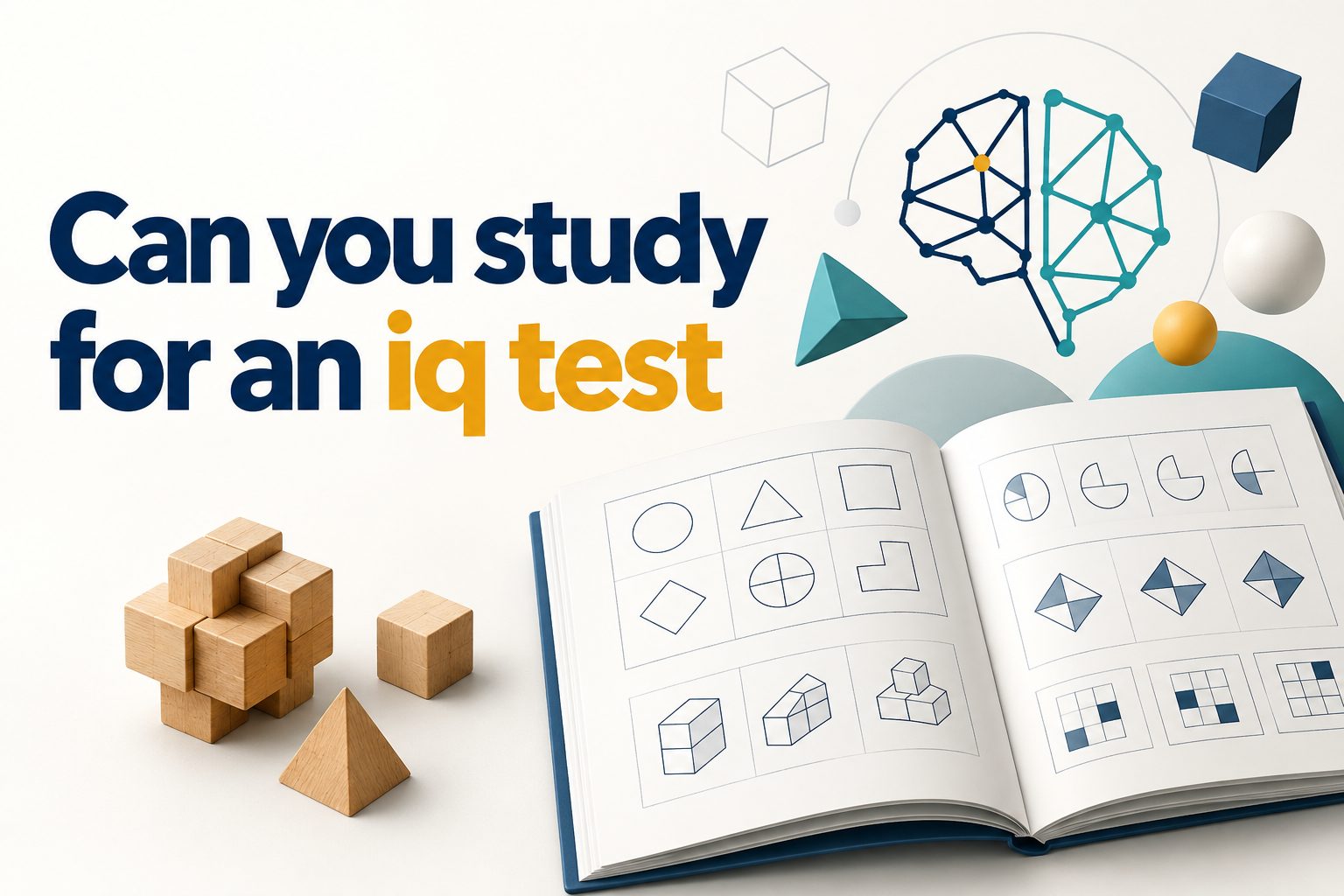
Many people ask, “Can you study for an IQ test?” The honest answer is yes, but studying does not work in quite the same way as memorizing facts for a school exam. Preparation can help you become familiar with common question styles, manage time better, and approach unfamiliar problems more calmly.
IQ tests usually measure several thinking skills, such as pattern recognition, verbal reasoning, working memory, spatial awareness, and logical problem-solving. Practice may improve how efficiently you use those skills during a test, especially when the format is new to you.
The goal of preparation should be to show your current abilities fairly, not to chase a label or treat one score as a complete measure of intelligence. This guide explains what you can study, what realistic improvement looks like, and how to prepare without wasting effort.
An IQ score is a standardized result that compares performance with people in a similar age group. Different tests emphasize different abilities, so a score can be influenced by the test design, testing conditions, language background, health, and familiarity with timed questions.
Some parts of an IQ test are more trainable than others. You can learn efficient methods for matrix puzzles, number sequences, vocabulary questions, and visual rotations. You can also reduce avoidable errors caused by rushing, anxiety, or misunderstanding directions.
Preparation does not mean that every practice gain represents a permanent change in broad intelligence. Often, it reflects better test-taking skill, improved concentration, and knowledge of how to recognize recurring puzzle structures. Those are still useful improvements when a test matters to you.
A responsible approach keeps the result in perspective. IQ tests can offer one piece of information about certain cognitive abilities, but they do not measure creativity, character, motivation, practical judgment, emotional awareness, or every kind of talent.
If the assessment is formal, such as one given by a psychologist or school professional, follow its rules. Some settings limit practice materials because extensive coaching can make the result less useful for the purpose of the evaluation.
How Can You Study For An IQ Test?
Learn The Test Format
Start by finding out whether the assessment includes verbal, numerical, visual, memory, or timed reasoning tasks. Knowing the format prevents surprise and lets you divide practice time sensibly. Read directions carefully during practice, because many lost points come from solving a different problem than the question actually asks.
Practice Pattern Recognition
Matrix and sequence questions often ask you to identify a rule involving shape, direction, number, shading, or position. Work slowly at first and state the rule in plain language before choosing an answer. Over time, compare rows, columns, and changes rather than relying on an immediate guess.
Build Basic Number Fluency
For numerical reasoning, review common relationships such as addition, subtraction, multiplication, division, squares, doubling, alternating patterns, and simple proportions. Mental arithmetic matters because it frees attention for the larger pattern. Focus on accuracy first, then use short timed sets to develop a comfortable pace.
Strengthen Verbal Reasoning
Verbal items may involve analogies, definitions, categories, or short logic statements. Reading regularly helps, but targeted practice is useful too. When answering an analogy, identify the exact relationship between the first pair, such as part to whole, tool to purpose, or cause to effect.
Use Timed Practice Carefully
Timing is valuable once you know how to solve a question type. Set a realistic limit for a small group of questions, then review every error afterward. If you only race through items, you may reinforce careless habits instead of learning a better strategy.
Review Errors By Category
Keep a simple record of mistakes: missed rule, arithmetic slip, unclear vocabulary, slow visual rotation, or rushed reading. This makes practice more focused than repeatedly taking full tests. A pattern in your errors tells you what to train during the next short session.
Simulate Test Conditions
Before an important assessment, complete one or two practice sessions in a quiet place with no phone, interruptions, or extra help. Use the expected time limit where possible. This helps you test your pacing, attention, and energy while reducing uncertainty on the actual day.
What Can IQ Test Practice Improve?
1. Practice can improve familiarity with instructions and common item formats, so you spend less mental energy figuring out what a question is asking.
2. It can improve pacing by teaching you when to persist, when to make a reasonable choice, and when to move to the next item.
3. Practice may reduce test anxiety because familiar tasks feel less threatening and your preparation gives you a clear routine.
4. It can sharpen specific skills, including visual comparison, mental calculation, vocabulary recall, and logical elimination of weak answer choices.
5. Practice can reveal practical barriers, such as poor sleep, distracting noise, skipped meals, or uncomfortable timing, that affect performance but are not measures of ability.
Key Factors That Affect IQ Test Results
- Sleep: Adequate sleep supports attention, working memory, and emotional control. A late night of cramming is usually less helpful than arriving rested.
- Stress Level: Strong anxiety can narrow attention and make easy tasks feel confusing. A calm breathing routine and realistic expectations can protect performance.
- Test Instructions: Taking a few moments to understand the rules can prevent repeated mistakes. Ask permitted clarification questions before the timed portion begins.
- Language Familiarity: Verbal scores can be affected when the test language is not your strongest language. This should be considered when interpreting results.
- Health And Comfort: Hunger, illness, pain, dehydration, and an uncomfortable environment can reduce concentration. Plan basic needs before the assessment.
- Practice Quality: Focused review of mistakes is more valuable than taking many random quizzes. Good practice targets a skill and checks whether your method improved.
Best Ways To Prepare For IQ Test Questions
Set A Modest Study Schedule
Use short, consistent sessions instead of exhausting marathons. For many people, twenty to thirty focused minutes several times a week is enough to build familiarity. End each session with a brief review so you remember what worked and what caused difficulty.
Alternate Question Types
Rotate between verbal, numerical, visual, and logical tasks. This keeps practice balanced and helps you identify genuine weak areas. Spending all your time on favorite puzzle types can create confidence without preparing you for the full range of possible test items.
Explain Your Reasoning Aloud
After solving a practice problem, describe the rule you used in a sentence or two. If you cannot explain it, you may have guessed correctly without learning a repeatable method. Clear explanations make it easier to spot mistakes and transfer strategies to new questions.
Use Elimination Before Guessing
When an answer is not obvious, remove choices that violate the clearest part of the pattern. This is especially helpful in multiple-choice visual and verbal questions. A thoughtful elimination process is better than random guessing and often reveals the missing rule.
Protect Your Attention
Practice with notifications off and take a short break when concentration fades. IQ-style tasks often require sustained attention, and mental fatigue can look like lack of ability. Training your focus in a calm environment is a practical part of preparing.
Avoid Memorizing Answer Banks
Memorizing answers to specific online puzzles gives limited benefit and can create a misleading sense of progress. Prefer new problems that require you to recognize principles. The useful skill is identifying a pattern you have not seen before, not recalling a previous solution.
Plan The Test Day
Prepare simple logistics in advance: know the location or time, bring permitted materials, eat normally, and allow extra travel time. A predictable routine lowers last-minute stress. On arrival, read each instruction carefully and use a steady pace rather than trying to prove something on every item.
You can study for an IQ test in the sense that you can practice its formats, strengthen relevant skills, improve pacing, and reduce avoidable stress. Those changes can help your score reflect your performance more fairly.
The best preparation is focused and realistic. Work on patterns, reasoning, vocabulary, number fluency, and test conditions, then review errors instead of simply completing more questions.
Keep the result in proportion. An IQ test measures selected abilities in a particular setting, while a person’s potential and worth are much broader than any single score.
FAQs About Studying For An IQ Test
Can studying raise an IQ test score?
Studying can raise a test score, particularly when it improves familiarity with question types, timing, concentration, and problem-solving methods. The amount of change varies by person and test. A higher score after practice may reflect better test-taking skill as well as improvement in the specific abilities practiced.
How long should I study before an IQ test?
A few weeks of short, focused practice is usually more useful than intensive last-minute work. Try several sessions each week, then complete a practice run under quiet, timed conditions. Stop early enough to rest before the assessment rather than arriving mentally tired.
What should I study for a nonverbal IQ test?
For a nonverbal test, practice visual patterns, matrix reasoning, shape rotations, sequences, comparisons, and spatial relationships. Learn to check changes across rows and columns. You do not need advanced mathematics; careful observation and a structured method are often more important.
Is it cheating to practice IQ test questions?
General practice is not automatically cheating, but the context matters. If a clinician, school, employer, or program gives instructions about preparation, follow them. Repeated exposure to protected test items may reduce the usefulness of a formal score, so honest disclosure and appropriate materials are important.
Can anxiety lower IQ test performance?
Yes, anxiety can interfere with attention, working memory, reading accuracy, and time management. It does not mean you lack ability. Familiar practice, sleep, slow breathing, and a clear test-day routine can reduce pressure and help you focus on one question at a time.
Should I guess when I do not know an answer?
Follow the test instructions first, since scoring rules differ. In many multiple-choice settings, eliminate clearly wrong options and make the best choice if there is no penalty for guessing. Do not spend so long on one difficult item that easier questions later receive too little time.