
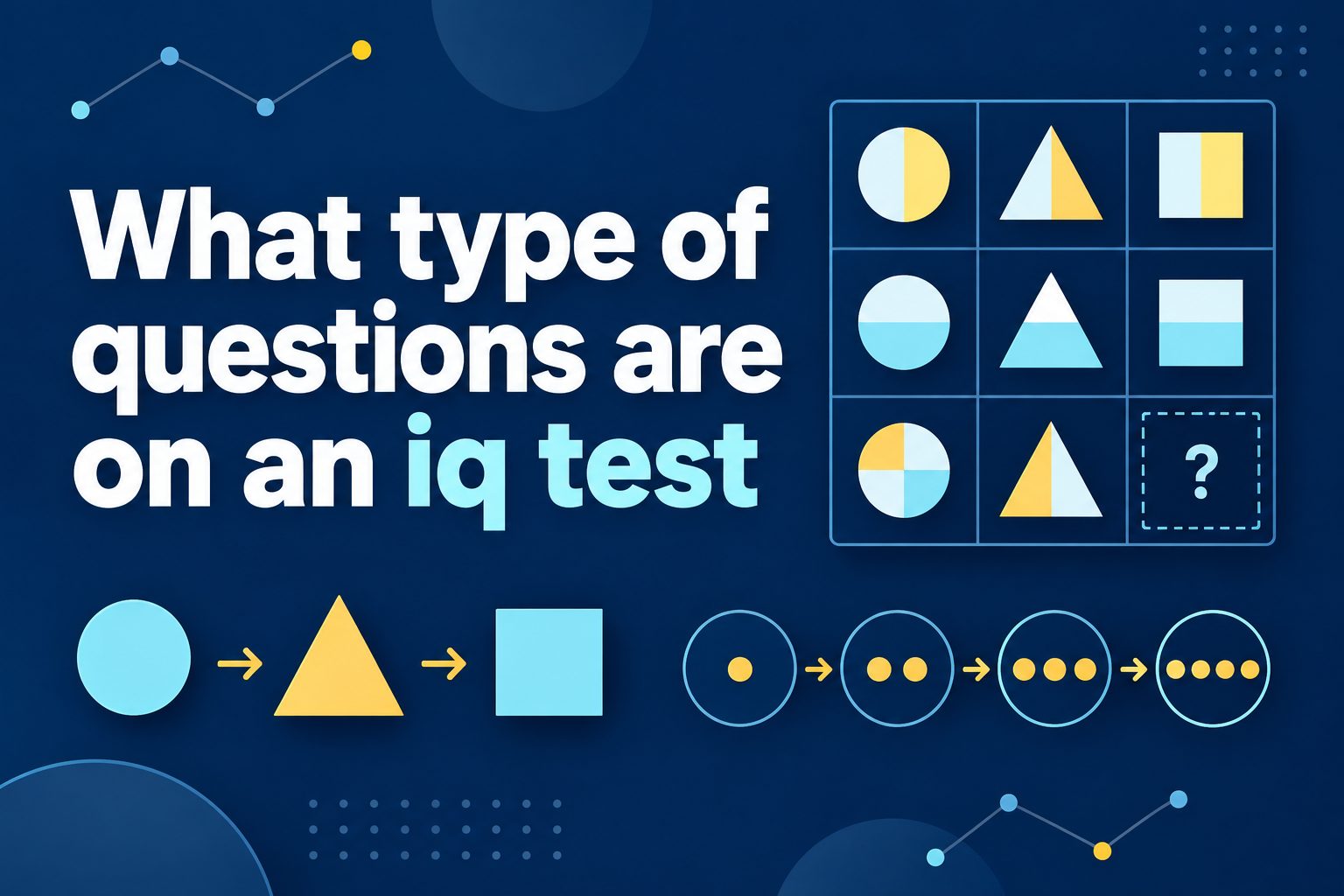
Many people wonder what type of questions are on an IQ test before taking one for school, work, research, or personal curiosity. IQ tests do not usually focus on memorized facts. Instead, they use structured problems to explore how a person reasons, recognizes patterns, solves unfamiliar tasks, and works with words, numbers, and visual information.
A typical assessment combines several question styles because intelligence is not a single skill. One person may be especially strong with language, while another may quickly spot shapes, sequences, or numerical relationships. The mix of questions helps create a broader picture of cognitive strengths and areas that may need support.
This guide explains the most common IQ test question categories, what they measure, how to approach them calmly, and what an IQ score can and cannot tell you. The exact format varies by test, age group, and examiner, but the underlying reasoning skills are often similar.
IQ tests are designed to measure performance on selected mental tasks under standardized conditions. They are not quizzes about how much someone has read, where they went to school, or whether they are talented in every area of life.
Most professionally administered tests are divided into sections. Each section contains questions that become harder or use a different kind of thinking, allowing the examiner to compare performance with age-based norms.
Some questions are spoken aloud, some are printed, and others use blocks, pictures, symbols, or timed puzzles. Young children may receive more hands-on or picture-based tasks, while adult tests often include more verbal and numerical reasoning.
A score is most useful when viewed with context. Sleep, anxiety, language background, health, attention, and familiarity with testing can all affect how a person performs on a particular day.
The practical value of an IQ test lies in identifying patterns. For example, a large difference between verbal reasoning and processing speed may help a professional decide what further assessment or support could be useful.
What Questions Appear On An IQ Test
Verbal Reasoning Questions
Verbal reasoning questions examine how well you work with language and concepts. You may define a word, explain how two objects are alike, select a word that completes a sentence, or identify a relationship between ideas. These questions reward clear thinking and vocabulary, but they are not simply spelling tests.
Number Sequence Questions
Number sequence questions ask you to find the rule connecting a series of numbers. A sequence might increase by a fixed amount, alternate between two patterns, multiply, divide, or combine earlier numbers. The key is to test simple relationships before assuming the rule is complicated.
Pattern Recognition Questions
Pattern recognition questions use shapes, symbols, or images that change according to a rule. You may need to choose the missing image in a row or matrix. These items measure the ability to notice visual relationships without relying heavily on language or learned facts.
Spatial Reasoning Questions
Spatial reasoning tasks assess how you mentally handle objects and positions. Common examples include rotating a shape, identifying which pieces create a design, folding a paper figure in your mind, or choosing the matching view of an object. Drawing skill is not required; mental organization matters more.
Logical Deduction Questions
Logical deduction questions provide a few statements and ask what must, could, or cannot be true. They may involve seating arrangements, categories, comparisons, or conditional rules. Good answers come from following only the information provided rather than adding assumptions from everyday experience.
Working Memory Questions
Working memory questions test how well you briefly hold and manipulate information. An examiner may read a list of digits and ask you to repeat it forward, backward, or in numerical order. Other tasks may require remembering a sequence of pictures, symbols, or locations.
Processing Speed Questions
Processing speed questions are usually timed and involve quick, accurate scanning or matching. You might pair symbols with numbers, find a target among similar items, or mark whether two forms match. They measure efficient visual attention and careful pace, not whether someone is more creative or more valuable.
Why IQ Tests Use Different Question Types
1. Different question types prevent one narrow ability from dominating the result. A person with strong vocabulary should not automatically receive the same profile as someone with excellent visual reasoning.
2. Verbal items can reveal how a person forms concepts and communicates relationships. They are particularly helpful when evaluating language-based learning strengths.
3. Nonverbal patterns can reduce the influence of formal education and vocabulary. They offer another route for showing reasoning ability, especially when language is a barrier.
4. Memory tasks show how much information a person can keep active while following instructions or solving a problem. This skill affects many everyday learning demands.
5. Timed tasks add information about speed and attention. A slow score does not automatically mean weak reasoning, but it can explain why work feels harder under pressure.
Key Factors That Shape IQ Test Performance
- Test Conditions: A quiet setting, clear instructions, and appropriate breaks help the score reflect ability more accurately than a rushed or distracting environment.
- Sleep And Health: Fatigue, illness, pain, hunger, or medication changes can make concentration and processing speed noticeably less consistent.
- Language Experience: People taking a verbal test in a less familiar language may understand the reasoning but lose time or miss subtle wording.
- Test Anxiety: Worry can use up working memory and lead to rushed choices. Feeling nervous is common and does not mean someone lacks ability.
- Attention And Motivation: Tasks requiring sustained focus may be harder when a person is distracted, bored, overwhelmed, or managing an attention-related difficulty.
- Practice Familiarity: Knowing the general format can improve comfort and pacing, although legitimate tests are designed so simple memorization cannot replace reasoning.
How To Approach IQ Test Questions
Read Or Listen For The Exact Task
Before solving, identify what the question actually asks. Is it asking for the next item, the missing item, the best definition, or the one statement that must be true? A correct solution to the wrong task still earns no credit, so pause briefly to set the goal.
Look For The Simplest Rule First
In sequences and patterns, begin with obvious changes such as addition, subtraction, rotation, repetition, size, shading, or position. Many people lose time by searching for an advanced explanation before checking a straightforward rule that fits every item.
Use Elimination Carefully
When choices are available, remove options that clearly break the pattern or contradict the stated facts. Elimination is especially useful for spatial and logic questions, but avoid choosing an answer merely because it is the only one left after careless assumptions.
Break Complex Problems Into Parts
A visual matrix may change in more than one direction, and a word problem may contain several relationships. Examine one row, column, or condition at a time. Separating the pieces makes it easier to see whether color, number, orientation, or category is changing.
Manage Timed Items With Balance
Timed sections reward steady movement, not frantic guessing. If an item remains unclear after a reasonable effort, follow the examiner's instructions and move on when possible. Spending too long on one hard problem can reduce the number of easier items you complete accurately.
Avoid Outside Knowledge When It Is Irrelevant
Logic questions should be answered from the given statements, even if the scenario seems unrealistic. Treat the conditions like rules of a small game. Real-world knowledge can be useful in verbal questions, but it should not override explicit information in the item.
Stay Calm After A Difficult Question
Well-designed IQ tests include questions that many people will not solve. Reaching a hard item is not a sign that you are failing. Let it go, refocus on the next task, and allow the overall pattern of responses to represent your performance.
The question types on an IQ test usually include verbal reasoning, number patterns, visual logic, spatial tasks, working memory, and processing speed activities. Each category looks at a different part of how a person handles information.
The best way to approach these questions is to read carefully, search for simple rules, work methodically, and keep your pace steady. Preparation should focus on familiarity and confidence rather than trying to memorize answers.
An IQ result is one piece of information, not a complete definition of intelligence, potential, character, creativity, or future success. Its meaning is strongest when considered alongside real-life skills and professional context.
FAQs About IQ Test Questions
Are IQ Test Questions Mostly Math Questions?
No. Some IQ tests include number sequences or quantitative reasoning, but math is only one possible area. Many questions use words, pictures, shapes, memory tasks, logic rules, or timed symbol matching. A person can perform strongly on visual or verbal tasks without being especially interested in school mathematics.
Do IQ Tests Test General Knowledge?
Most formal IQ tests try to limit the role of general knowledge because they aim to measure reasoning rather than schooling alone. Some verbal items depend partly on vocabulary and learned concepts, but test designers balance them with nonverbal tasks that use patterns, images, and unfamiliar problems.
Can You Study For An IQ Test?
You can prepare by becoming familiar with common formats, practicing calm test habits, sleeping well, and asking what to expect. However, a valid assessment is not meant to be mastered through memorized answers. Excessive coaching can make results less useful for identifying your everyday cognitive profile.
Why Are Some IQ Test Questions Timed?
Timed questions help measure processing speed, visual scanning, attention, and efficient decision-making. They are only one part of a larger assessment. A lower timed score may reflect careful work, anxiety, motor speed, attention, or fatigue, so it should be interpreted with the rest of the results.
What Happens If You Do Not Know An Answer?
Not knowing an answer is normal, especially as questions become harder. On an untimed item, make a thoughtful attempt based on the available information. On a timed task, avoid getting stuck for too long. Professional tests are designed so that few people answer every item correctly.
Do Online IQ Quizzes Use The Same Questions?
Many online quizzes use pattern and sequence questions that resemble parts of IQ testing, but their scoring, timing, norms, and quality vary greatly. A short quiz may be entertaining, yet it usually cannot provide the careful interpretation or standardized comparison offered by a qualified professional assessment.